
Pulling Back to the Monthly Perspective in US Stocks
With US Equity Indexes challenging and breaking to new recovery highs, it can be helpful to take a moment to raise your perspective to the monthly chart frame.
Let’s take a quick look at the monthly index charts, starting with the S&P 500:

The S&P 500 lags the Dow and NASDAQ at the moment, as it has not yet broken officially to new recovery highs beyond the May 2011 peak (1,370).
Nevertheless, we can see the bigger picture structure over the last 15 years in the chart above.
The key “narrative” highlights would be the pre-2000 “Tech Bubble” run-up, post 2000 crash and recession, stable recovery into the 2007 peak, 2008 financial crisis, and the current liquidity-infused recovery.
We’ll also discuss a chart-based theme regarding “Open Air” on further bullish movement above these key chart levels.
Next, the Dow Jones Index:
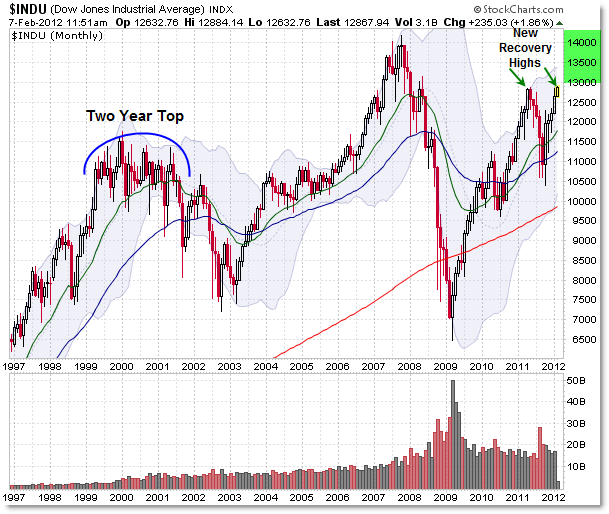
Interestingly, when compared to the S&P 500, the Dow Jones had less of a severe decline during the 2000 to 2003 bear market and a stronger recovery from 2003 to the 2007 peak.
The 2008 crisis bear market and 2009 to present recovery are structurally similar, except that the Dow Jones broke to new recovery highs this week.
The NASDAQ has the most unusual historical chart of the three big indexes, due to the 2000 period:
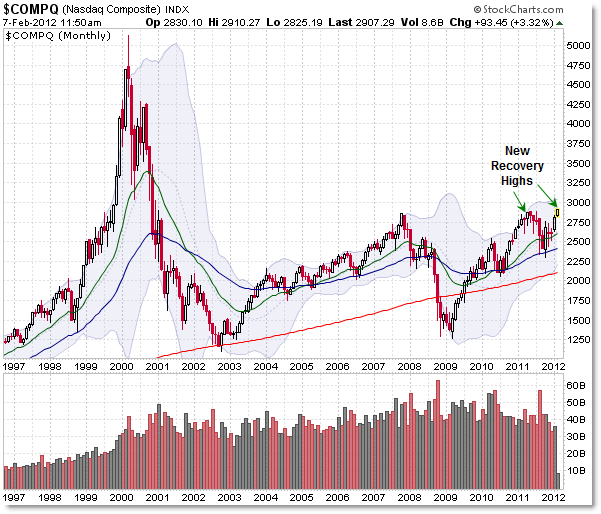
The 2000 period centered around the “Tech Bubble” run-up to the 5,000 index peak and subsequent Tech Crash from 5,000 to 1,250.
Beyond the steepness of the spike and fall at the beginning of the decade, the NASDAQ has one more unique quality when compared to the Dow and S&P 500:
The NASDAQ has twice pushed to new recovery highs ABOVE the 2007 peak, bringing the NASDAQ into price territory not seen since 2001’s crash period.
What’s the Main Idea Now?
As mentioned in prior posts, “Creeper Trends” can carry price further than many traders think it can go.
It can be financially devastating to fight a strong – or even creeper – trend in price.
As price breaks visual (obvious) resistance areas on the charts, it forces traders to make adjustments accordingly, particularly the higher price travels beyond these levels.
Short-sellers must determine how much conviction they have in their positions, and set a point where they will liquidate their positions.
Sidelined investors and traders may interpret a break to new recovery highs, and the media attention that accompanies it, as a reason to invest more money into the stock market (put on new positions) or else add additional capital to existing positions.
Either way, sustained breakouts tend to propel prices even higher as these traders and investors interact – some gladly entering new positions; others sadly exiting losing positions.
You can look to prior ‘Big Picture” levels to see how this situation played out, particularly during the low-volatility “Creeper Trend” from 2004 to 2006.
The indexes took a powerful run higher into the 2007 peak.
A similar powerful breakout/sustained rally occurred in late 2010 on the firm breakthroughs above the 2010 “Flash Crash” April highs.
From an unbiased game-planning perspective, if sellers do not stop the advances in the markets into these “obvious” price levels, we may very well see a Paradigm Shift that propels these indexes through the “Open Air” above the 2011 highs in a similar method as past “major” breakouts.
Key levels are often Battle Zones for buyers and sellers… but eventually one side wins the battle.
If the bulls win here at the “Battle for New Recovery Highs,” then we may be watching history in the making as the indexes begin a new journey towards their 2007 peaks… which the NASDAQ has already accomplished.
Corey Rosenbloom, CMT
Afraid to Trade.com
Follow Corey on Twitter: http://twitter.com/afraidtotrade
Corey’s new book The Complete Trading Course (Wiley Finance) is now available!
Dow performance looks better because they keep throwing out losers like C BAC AIG and the weighting assigned to IBM.
“Liquidity infused” is correct. Very dangerous when combined with an election year where they must pull out all the stops (see employment BLS BS fraud as another example). They will take this sucker wherever they want it and we will like it. The market valuation is the illusion all is well with the world. That illusion will break one day and when it does we all better be ready for the worst.
Thanks for a great blog and your fine work.
all the index's are now skewed by few stocks and etfs.
It is really nice for me to see you and your great hard work again.Every piece of your work look excellent.Looking forward to learning more from you!
Nice blog, its great article informative post, thanks for sharing it. Thanks for the information!
Admirable work and much success in your business dealings!
quite informative, your words could be meaningful for many of us, thanks for sharing.
The increase seen in volatility,TVIX, VIXY,VIXM, on February 9, 2012, illustrates the rising fears of Greek default.
I comment on the Bloomberg report ECB Taking Losses on Greek Debt May Sink Italy, that when the ECB takes a loss on Greek debt, the political gears will turn for a one Euro govenment, that is a European super state. Fate is working through creative destruction to create a Federal Europe.
Europe shares are trading lower in overnight trading suggesting that futures will turn lower immediately prior to opening on Friday on February 10, 2012. This will bring an end to the LTRO ponzi financed rally and introduce a stock market downturn.
this really a informative post and i am agree with theyenguy he has well said the rising fear of Greek.
Amazing write-up! This could aid plenty of people find out more about this particular issue. Are you keen to integrate video clips coupled with these? It would absolutely help out. Your conclusion was spot on and thanks to you; I probably won’t have to describe everything to my pals. I can simply direct them here!
Les femmes veulent bien paraître. Ils flattent la mode Que leur chiffre est élégant et Basket Nike Pas Cher
à la Sametime. Aussi Big articles filles vêtements pour tous ce qui leur donne Chaussures Basket Nike
la minceur. Toute femme peut être belle si elle sait quelques trucs pour aider de son mieux.Nike Shox Pas Cher
1. Le noir n'est pas la meilleure couleur pour grande fille. Pantalon noir de couleur,basket pas cher
robes, jupes et autres vêtements de taille plus n'est pas nécessairement chaussure nike pas cher
la figure la plus flatteuse minceur ou sur le corps de la femme. Une tenue attrayante,Chaussure Nike Shox
c'est autant Proportion, la couture et le style global, car elle est sur la couleur.Nike Air Shox
Vous devriez essayer quelque chose dans la couleur que vous faire plus jeune et gai. Choisissez des couleurs flatteuses et les jumeler avec black.
Really great work!I have gotten some new idea and important information about Stocks Index that you shared on this post.Thanks a lot.