
The 10-Year Relationship Between the SP500 and Fed Funds Rate
With April 28th’s Fed decision to keep the Fed Funds rate unchanged, let’s take a look back on the last 10 years to see the relationship between the Fed Funds Rate and the S&P 500 … which might be very surprising to you.
(Click for full-size image)
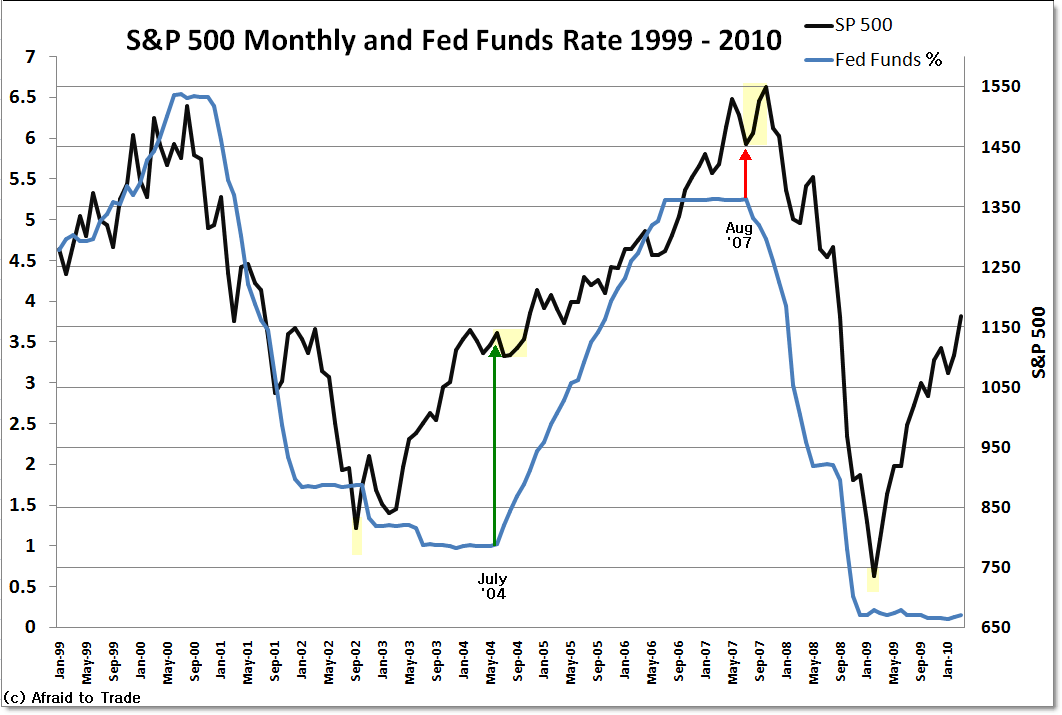
Starting our comparison in January 1999 and running to March 2010, we see the following relationship between Rates and Stocks over the last 10-year period.
I initially raised this topic (and the warning) after the Federal Reserve began its first rate cut in August, 2007, asking the question:
“Is Fed Rate Easing Really Good for the Market?”
First, of course Fed Rate cutting is good for businesses, as it allows them to borrow at a reduced rate, so that’s not at issue. That is in fact a whole separate discussion on fundamentals of credit.
What is at issue is the policy of the Federal Reserve which ties interest rate decisions and policy to economic fundamentals as they exist now and into the future.
For whatever reason, stocks and interest rates changed historical course and formed a strong positive relationship beginning in 1998 that carries forward to this day.
The Federal Reserve will lower rates when it sees that it needs to spur activity and ease credit to inject capital into an economy they see weakening into the future… which often corresponds with a falling stock market. Rate cuts cannot put an immediate stop to a falling economy.
On the same note, the Federal Reserve decides to raise rates when it feels the economy is strong enough to absorb a tightening of credit to keep inflation in check from a rising economy… which corresponds with a rising stock market.
This gives rise to a positive correlation between Federal Reserve “Fed Funds” rate and the S&P 500 (similar with the Discount Rate and any US Equity Index).
In fact, taking the data from January 1999 to March 2010, the correlation between the Fed Funds Rate and the S&P 500 is 0.818 which is a strong positive correlation (note not 100% correlated).
Look at one reason why the correlation is not 100%.
Notice the year-long lag between the stock market bottom in October 2002 (technically March 2003) and the Fed’s first interest rate hike in July 2004. The stock market rallied over 40% between the bottom and the first rate increase.
The stock market bottomed also in March 2009 and has rallied 75% off the lows and the Federal Reserve has keep rates uncharacteristically low for over a year now, fueling the stock market rally and economic recovery (along with other liquidity easing activities).
What is the case now?
If recent history is a guide, it will be a welcome sign to the market when the Federal Reserve decides to raise interest rates… just as it was a very unwelcome sign to the market when the Federal Reserve began cutting interest rates for the first time in August 2007.
In both cases of recent changes in policy, the market fell in July 2004 at the first Rate hike and rallied in August 2007 at the first Rate Cut. I posted on the rate cuts and the relationship between bonds and stock at this time (February 2008).
However, these victories were very short lived. Instead of plunging off to new lows after the July 2004 hike, the market ran to new highs in October 2007.
By the same token, instead of beginning a new roaring bull market where the Dow Jones rose to 20,000 after the first Rate Cut in August 2007, the market swung to a final new high, peaked, and dropped over 50% into the March lows.
History is a guide rather than an absolute (in fact, the correlation was just the opposite from 1980 to 1995), but if the past is prologue, a future Rate Hike later this year will not send the market spiraling to a new low (though the market may sell-off initially on the news) and in fact perhaps should be interpreted as a vote of confidence for the future of a recovering economy.
Corey Rosenbloom, CMT
Afraid to Trade.com
Follow Corey on Twitter: http://twitter.com/afraidtotrade
Hi Corey,
Thanks for the post.
I think you've hit on it or at least hinted at the real issue. Since 1995, the Fed Funds rate has been a mechanism to draw out and encourage stock market gains. I believe the fundamental thing that happened in 1995 is that the FED became to understand that the stock market WAS the economy and if the stock market could be propelled higher – citizens would be happy and the stock market would actually drive economic fundamental growth.
Once they saw the effectiveness of the Fed Funds tool each and every new crisis became a new excuse to inflate the bubble higher. Long Term Capital, Y2K, 9-11, etc have all been reasons for rate action and liquidity pumping.
Where I'm going with this is that the Volker era included the 1980 to 1995 period you mentioned — which was quite different in its overall trend.
So, to wrap up, we are faced with only one question now as the Bernanke era is simply a continuation of the Greenspan bubble. When do we get out of the market? Because what your data suggests – the answer will be when the asset bubble is so big that the resulting explosion will so horrible that Ben has to cut rates. The answer is…. it won't be for a long time from now because as usual rate increases will be delayed way too long which will simply cause the next implosion.
I will write a blog post about this tomorrow. I will link to your chart if that is ok with you.
Stay long.
Goatmug
The analysis here is correct, but traders should be careful about extrapolating this to an overall market outlook.
First, we can't assume the Fed will raise rates any time soon. The fact that they haven't reinforces their lack of confidence in the recovery, which raises the strong possibility of a double dip. Until they raise rates, it is a vote of no confidence. Japan did not raise interest rates for many, many years, and as you would expect, their economy went through a period of stagnation with multiple contractions and dips. I am expecting something similar in the US myself. A change in monetary policy could change my mind about that.
Second, as pointed out in the article, there are periods where a higher fed funds rate has a negative effect on the market in a much bigger time frame than short term (although high rates in general do produce longer term appreciation in equities).
We can't assume that just because rates can't go any lower means there is no direction to go but up. The fact that they are so low to begin with is very bearish.
The multiple contraction period in the US will be driven by the following forces:
–A new wave of defaults on mortgages from borrowers in the 2003-2007 boom. Many are still underwater and face employment risk. This is supported by foreclosure data, which is already showing this second wave beginning. You can read about it here:
http://www.housingwire.com/2010/02/16/foreclosu…
–All the people buying homes now (the so-called recovery in housing) foreclosing again in the next few years as they lose their jobs.
–The direct cause of more foreclosures: all the people getting hired in this expansionary phase getting laid off again (or workers being churned) as the economy begins to contract.
Today's GDP report reinforces this outlook. A +3.6% gain is a very weak reading, certainly worse than the prior quarter, showing a weakening effect of loose monetary policy to have any lasting effect in the US economy.
Well , the view of the passage is totally correct ,your details is really reasonable and you guy give us valuable informative post, I totally agree the standpoint of upstairs. I often surfing on this forum when I m free and I find there are so much good information we can learn in this forum! http://www.brfinder.net/