
The VIX and the Powerful 200 day SMA
Sometimes it’s the simplest things that make the most difference/impact.
Take for example the daily VIX – Volatility Index – and its 200 day Simple Moving Average:
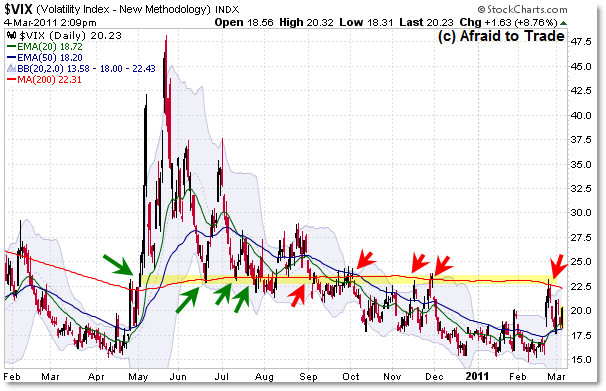
While there are other standard indicators on the chart, let me call your attention to the flat red line – the 200 day simple moving average.
The VIX broke sharply through the 200d SMA initially in April 2010 and in a big way early May (think “Flash Crash”) as Volatility Surged and price (stocks) collapsed.
The VIX fell to the 22.50 level again – 200d SMA – but this time the average provided support as the VIX made it back to 37.50.
The 200d SMA provided minor support until price cleanly broke the level (making a new low) in September, at which point the average then switched over to providing resistance/peaks for the VIX.
Through 2011, the VIX has remained under the 200d SMA and just recently, the key average repulsed a rally again to 22.50 – turning back the VIX dead in its tracks.
So the main idea here is to watch the VIX relative to its simple 200d SMA:
A breakout above 22.50/23.00 could be treated as a major trend reversal signal that could lead to another spike in volatility – but of course watch for the triple-stock market indexes to break their key daily support (1,300/1,280 in the S&P 500, for example).
Until then, expect Volatility to be contained under this level and for the VIX to decline particularly in the event the triple-indexes break above their recent new recovery highs (including 1,345 in the S&P 500).
Corey Rosenbloom, CMT
Afraid to Trade.com
Follow Corey on Twitter: http://twitter.com/afraidtotrade
Corey’s new book The Complete Trading Course (Wiley Finance) is now available!
Thanks for what you do. Ya gotta throw a bone to Mr Vix though as it's held higher lows above the 10 and 20dma while the various indices were advancing smartly. There was some chunky volume in the calls today. The 25 strike did almost 80k at the ask. Thanks again!