
Lesson: The Four Early Warning Signals Given Before the Afternoon Reversal
Were there chart signals the market gave ahead of the afternoon reversal and breakout into the close after the morning Jobs Report drop?
Absolutely – it turns out there were at least four early signs that odds had shifted away from the bears and towards the bulls which was confirmed with the afternoon breakout.
I wanted to share a lesson I shared in tonight’s Idealized Trades report – the four chart signals that warned of a likely turnaround in the market. These are classic technical signs that can signal a potential change in trend and it’s important to know them.
Let’s start with the 5-min @ES (S&P 500 e-mini futures contract – similar to the SPY ETF) chart:
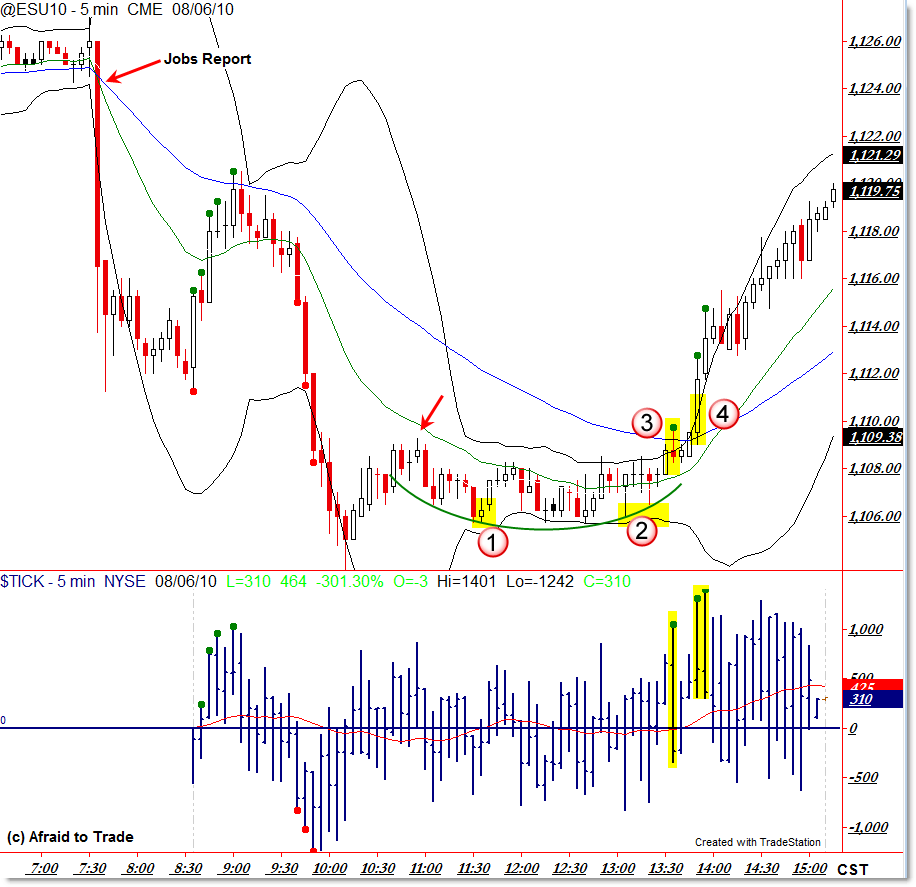
(click for full-size image)
What I do in the first section of each night’s report for members is teach applicable trading lessons from the current day’s activity for use when these signals/trades appear in the future.
Let’s start with the four signals I’ve identified that the market gave in advance of the afternoon breakout – which could have given you ample warning to exit your intraday short-sales and/or get long to play the breakout as it developed.
1. Failed Impulse Sell
Generally, after a market makes a new price, momentum, and TICK (market internals) low, we would expect lower prices yet to come. A good trade set-up – that I call the “Impulse Sell” – occurs when price rallies into resistance after a sharp downward thrust. We expect lower prices ahead.
However, when a high-probability trade set-up fails – as happened in this case when the market traded lower but did not retest the session low – then that is an initial sign of hidden bullish strength that the bulls ‘thwarted’ or busted a classic sell signal.
That’s not enough to expect a reversal, but it is the first clue that “Things may not be as bearish as they seem” or “Bulls may be stronger than the chart is revealing – as they just busted a sell set-up.”
2. Rounded Reversal Formation
In the reports, I define three types of intraday structures: Trend Day, Range Day, and Rounded Reversal. Rounded Reversals are the ‘enemy’ of trend days.
You can also think of it as a “Scallop” or “Arc” pattern, but when price takes on the form of a rounded arc, I call this a “Rounded Reversal” and it has bullish implications of a slow but steady/stable reversal.
I drew a green arc under price to show the curvature of the market that also showed hidden bullish strength building.
3. “Kick-off” Sign of Strength
We monitor TICK in relation to price highs and lows for confirmation/non-confirmation. TICK should roughly mirror what’s happening in price. Anything unusual – like a divergence – sends a signal.
A “Kick-off” occurs when the TICK makes a new intraday high while price is NOT making an intraday high – and the further price is away from making a new intraday high, the more powerful the Kick-off Signal is.
Look at #3 at 1:30 CST (13:30). I created an indicator to overlay TICK highs on the price chart, as revealed by little green dots. It helps me see the signal better to spot divergences and Kick-off signals – like this.
If you look only at price, you would say “Oh – price is making a new swing high” but if you compare to TICK, you see yet another “Hidden Sign of Strength” as TICK pushed up to a new high on the session.
That is a very blatant sign of strength that many traders miss – and it is a very powerful signal that odds strongly favor higher prices yet to come.
4. Bollinger Band and 50 period EMA Breakout
I’m not sure this gave you much of a ‘warning’ but it was the final signal needed – the final nail in the bearish coffin for the day – that odds strongly favored a reversal. This was your execution signal to get long – or take your stop-losses if you remained in an intraday short-sale position.
In a very strong candle, price sliced through the upper Bollinger Band and 50 period EMA (blue line) at 1:50 CST. You can get long on the break to new swing price highs to play for a bullish breakout to materialize – I call this a Positive Feedback Loop because short-sellers are rushing to the exits to stop-out and buyers are now trading long for the breakout.
We would thus expect price to rally higher as long as the positive feedback loop was in effect – and when they form, they can often go longer than expected – and in this case boosting the market almost all the way to break-even on the session.
Again, these are the kind of lessons and examples I consistently teach/describe each day in the daily subscriber reports.
Lessons like this can mean the difference in holding stubbornly short after price broke-out into the afternoon session, or playing long to profit from the breakout.
The market gave signals and created a narrative of hidden bullish strength… that culminated with a powerful breakout in the close.
Corey Rosenbloom, CMT
Afraid to Trade.com
Follow Corey on Twitter: http://twitter.com/afraidtotrade
Short and sharp analysis. Any analysis on VIX trending down further?
Do you have any projections for Monday?
Thanks for those lessons Corey.
I had been wondering all night why new momentum lows were made, but not also made in price.
I was looking for an afternoon entry for TNA.
On the 30 minute intervals, I saw positive divergence forming with MACD that formed a buy signal in the morning, so I knew there'd be a strong rebound. But when I viewed the 5 minute interval charts, Lower lows were being made in momentum. So I avoided buying on the morning signal (using 30 minute intervals), and instead sat, waiting, all day, looking for the optimal entry on 5 minute intervals (to confirm the buy sig that I had already received on the 30min int's). A lower low in price some time that afternoon would indicate a buy opp – preferably just under the morning low of $40.80.
I was sitting waiting all day for charts to reverse… around the time that it would have started to form (1:45pm – $41.55), TNA gave me a weak buy signal. I ignored it b/c I continued to think that price would make a lower low. It never did. TNA went on to close at 43.33.
What are your views on using smaller intervals to confirm an entry for larger intervals – ie, using 5min intervals to confirm what you see on 30min intervals… or using 30min to confirm and get a better entry price for what is forming on the daily…
Thanks Corey!
I figured the Jobs Report would settle/break us out of this range but we're right back where we ended on Thursday – so I'm trading day by day the intraday frame with a neutral attitude. A break either way – above 1,130 or under 1,100 (actually 1,090) should lead to a continuation move but until then, keep trading the 'scalps' between.
Definitely – I teach that in some of the webinars/intraday reports specifically.
On each report, I show the 30, 60 and daily chart and discuss expectations/potential set-ups from them. From there, with an expectation in mind (example – market is likely to hit support and bounce because it is forming positive divergences) then you execute that expectation on lower timeframe structures such as intraday TICK divergences at the low, trendline breaks, or complete 5-wave fractals… or reversal candles, etc.
Yes – gain perspective/expectations from the higher and execute them with technical signals on the lower frames.
Corey, excellet. thanks.
any explaination why the rally failed at 9:00?
and most important, what's to be expected next? testing Aug 4th top and breaking above?
please explain the membership. how often is the updates…
Cool lesson, short and sweet, tried to buy a few of your premium lessons, but pay pal was being difficult.
Equity tends to reverse the initial movement made on NFP release. Out of the ten worst job report relative to expectation, the SPX index managed to achieve 1.41% average return.
http://realmarkettrend.blogspot.com/