
Multiple Convergences Mark Intraday Low Lesson
Yesterday, May 21st offered an excellent opportunity to demonstrate how multiple confluences of non-correlated methods can lead to powerful intraday turning points – in this case, the absolute price low of the day. Let’s take a look at how we could have known with a high degree of confidence (but not certainty) that $88.25 was the absolute pivot low that preceded a powerful rally in the SPY (and similar structure to the QQQQ and DIA ETFs).
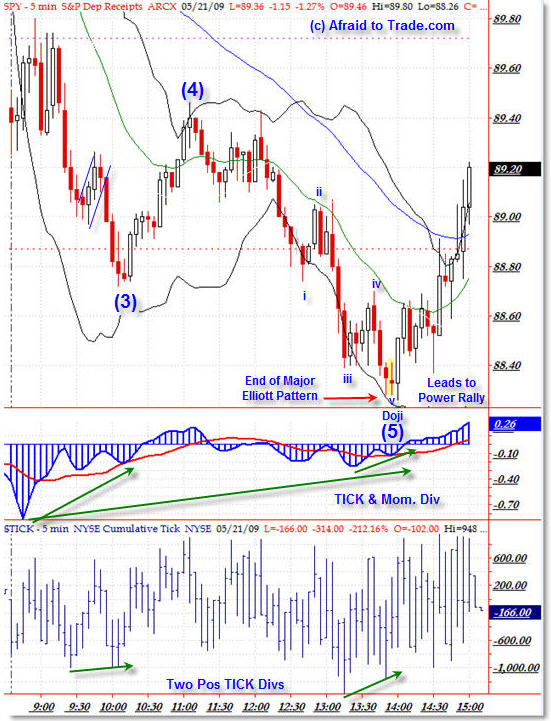
If the whole chart seems jarbled, keep this in mind – I’m only discussing the highlighted ‘doji’ candle at 2:00 CST. Everything else builds upon that candle as the powerful reversal pivot.
For reference, we’re looking at the 3/10 Oscillator (any momentum oscillator will do) in the middle pane and the NYSE TICK in the lower pane.
As I mentioned in this morning’s post, we had a perfect Elliott Wave 5-wave move down into the final lows. That alone is enough for some Elliotticians to ‘get long’ at the final doji, especially given that we had a fractal (smaller) 5-wave structure complete at the lows.
When you have a smaller 5-wave fractal (from noon until 2:00pm) terminate to complete a larger 5-wave fractal (see earlier post), then you have a powerful “confluence” of terminal 5th waves. Despite this, I don’t take trades based strictly off Elliott Wave and suggest you don’t as well. You don’t even need to know Elliott Wave to know that the doji formed at an important level.
Beyond the two 5th wave completions, we had a large and small positive momentum divergence. Look closely at the new momentum low as the day opened with a gap and compare that reading with the absolute price low in the day at 2:00. Notice we had a large-scale positive momentum divergence.
Those don’t matter as much on Trend Days (until this point, we did have a trend day) but combine the larger divergence with a smaller positive divergence. Look closely at the lows at fractal “iii” and terminal fractal “v”. The 3/10 Oscillator formed a quick positive momentum divergence, hinting that a retracement at worst was coming and a trend reversal was in the cards at best – we got the reversal.
So now we have a short and long-term positive momentum divergence on top of a fractal fifth wave and a larger fifth wave. That’s powerful enough to initiate a trade for most people.
Look closely at the TICK – internal market indicator. It ALSO made a quick positive TICK divergence on the absolute low of the day. That adds a lot more weight than a standard momentum divergence, but you’ll often find TICK and Momentum divergences forming simultaneously – I believe TICK divergences are more powerful, however.
And if that wasn’t enough, you had a nice, clean-cut doji candle (which is often associated with price reversals) which was then followed by a type of bullish engulfing candle.
If all this at your fingertips doesn’t give you confidence to enter a long trade – or at least cover your short-sale trade at the lows – I’m not sure what does. You only see this in real time when you experience it multiple times and utilize non-correlated methods repeatedly, building experience.
To recap:
- Small Fractal (v) terminal 5th wave (“five of five”)
- Large terminal 5th Wave
- Large-scale (all day) Positive Momentum Divergence
- Small-scale (single swing) Positive Momentum Divergence
- Positive TICK (Internal) Divergence
- Doji Reversal Candle
- Bullish Engulfing Candle
- Bottom of the Bollinger Band (not discussed above)
This encapsulates how to trade professionally – use your knowledge of various strategies and experience to put the odds as much in your favor as you can by identifying sources of technical confluence, establish where you’re wrong (stop-loss), and then put on the trade and play for an appropriate target – but all that is beyond the scope of this educational post on multiple sources of confirmation.
Corey Rosenbloom, CMT
Afraid to Trade.com
Subscribe for the RSS Feed here.
Follow Corey on Twitter: http://twitter.com/afraidtotrade
How to read today`s chart May 22,2009 ?
I could not count Elliott Wave 5-wave. please advise and thank you.
thanks for this website.
check out sandp500analyst.com u seem to have some stuff in common
Panepon,
We don't get clean-cut Elliott Wave counts every day like this – this was a gem.
There was a 5-wave fractal that ended in a rising wedge (or ending diagonal) into the 10:00am $89.90 high but other than that, we were in a nasty correction all day until the end. Corrections aren't worth trading in my opinion – just stand aside until the structure is clearer.
Than kyou for your advise and now wonderling that next tuesday 26 May may be a
great drop(down) because this thursday and friday(21 and 22 May) were both down continuously.
Could that be called an inverted head and shoulders candlestick pattern at the low, as well?
Thanks Corey, I was looking for something like this. One question, where would you have made the “ideal” entry? You mentioned the “type of bullish engulfing candle” so does this mean you would not have entered immediatly after the highlighted doji? Thanks again and have a great memorial day.
corey, i appreciate your analysis. I am having trouble reconciling your advice to ignore tick and momentum divergences on trend days with your advice to put on a reversal trade based on them, in what was, until that point, behaving like a trend day Please clarify. thanks
I had noticed them as well and was actually going to get long but it was so late in the day i didnt expect a real reversal in the last 20 minutes.
actually i was wrong on the time frame- the bulk of the reversal move happened in the last half hour which is still fairly late imho
It was! I missed seeing that.
Small pattern, but valid nonetheless.
The more we can see as it's happening, the better!
Hey Dominick,
It depends on your trading strategy – if you were aggressive, you probably entered right at the doji (remember these are 5-minute bars so there's time to make a decision) or if you were conservative (needing more information) you would have entered after the engulfing completed.
Personally, I prefer to have my stop as close as possible and so I would recommend entering as soon as the doji formed and placing in a tight stop – but not too tight – my weakness is always stops that are too tight.
You too!
This is part of the art of trading – knowing the rules and knowing when to break them. Even if you completely ignored the TICK & 3/10 divergences, you would have been ok if short provided you got in early enough in the day (exiting at close with profit) or took a stop-loss when price broke above the 50 (triggering exit on trend day anyway).
But at a minimum, if you saw these developments, it was probably best to go ahead and cover your short positions and not hold through an expected retracements – divergences only 'forecast' retracements, not reversals unless confirmed by other structures (this one was, like the Elliott 5 wave fractals).
Agreed – I do most of my trading in the morning session and really only trade the afternoon session if there's a trend day but there can be some pretty stellar moves into the close on many days. I tend to do much better in the early morning session.
Could that be called an inverted head and shoulders candlestick pattern at the low, as well?
Thanks Corey, I was looking for something like this. One question, where would you have made the “ideal” entry? You mentioned the “type of bullish engulfing candle” so does this mean you would not have entered immediatly after the highlighted doji? Thanks again and have a great memorial day.
corey, i appreciate your analysis. I am having trouble reconciling your advice to ignore tick and momentum divergences on trend days with your advice to put on a reversal trade based on them, in what was, until that point, behaving like a trend day Please clarify. thanks
I had noticed them as well and was actually going to get long but it was so late in the day i didnt expect a real reversal in the last 20 minutes.
actually i was wrong on the time frame- the bulk of the reversal move happened in the last half hour which is still fairly late imho
It was! I missed seeing that.
Small pattern, but valid nonetheless.
The more we can see as it's happening, the better!
Hey Dominick,
It depends on your trading strategy – if you were aggressive, you probably entered right at the doji (remember these are 5-minute bars so there's time to make a decision) or if you were conservative (needing more information) you would have entered after the engulfing completed.
Personally, I prefer to have my stop as close as possible and so I would recommend entering as soon as the doji formed and placing in a tight stop – but not too tight – my weakness is always stops that are too tight.
You too!
This is part of the art of trading – knowing the rules and knowing when to break them. Even if you completely ignored the TICK & 3/10 divergences, you would have been ok if short provided you got in early enough in the day (exiting at close with profit) or took a stop-loss when price broke above the 50 (triggering exit on trend day anyway).
But at a minimum, if you saw these developments, it was probably best to go ahead and cover your short positions and not hold through an expected retracements – divergences only 'forecast' retracements, not reversals unless confirmed by other structures (this one was, like the Elliott 5 wave fractals).
Agreed – I do most of my trading in the morning session and really only trade the afternoon session if there's a trend day but there can be some pretty stellar moves into the close on many days. I tend to do much better in the early morning session.