
Traps Trendlines and Current Reference Levels for US Equity Futures
After a Bull Trap outcome sent equity prices back to the lower support boundary, let’s take a moment to update the key levels to watch in the US Equity Markets.
We’ll start with the S&P 500 and will use the futures contracts for our reference levels:

For simplicity, this post will focus on the key “Upper Resistance (red), Lower Support (green) and Midpoint Value Areas.”
For now, the S&P 500 is playing up off the 1,830/1,385 lower support level potentially toward the midpoint near 1,855.
We’ll frame the next likely swing as one “up off” support toward Midpoint Value… or else a continuation of the sell-swing and ejection of price down through lower support.
Clear Bull Traps developed in both the S&P 500 and Dow Jones Index last week:

For the Dow Jones @YM Mini-Futures Contract, the simple upper resistance level trades into 16,400 while lower support overlaps 16,100.
Price is currently playing up off 16,100 toward the Midpoint Value near 16,250.
With reference to the Bull Trap, see my post last week with respect to “Divergent Market Internals at the Highs” and the follow-up post yesterday “A Study Lesson on Lengthy Market Internal Divergences and Reversals.”
You can find an additional resource on the concept of “Traps and How to Trade Them.
Finally, the NASDAQ chart creates a different picture – that of a Falling Parallel Trendline Channel:

Price currently is playin gup off the 3,500/3,490 reference level potentially toward the 3,560 “Falling Value” Midpoint area.
Upper resistance is declining and currently intersects the 3,660 level.
Use these charts – and the ‘trap outcome’ lessons – for planning and trading as long as the range continues.
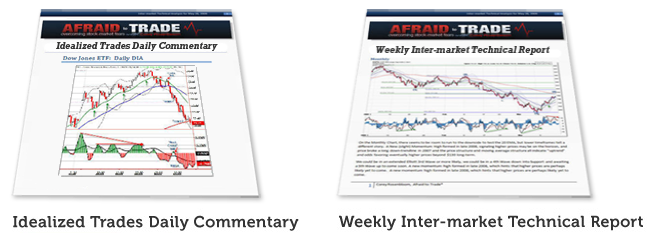
Follow along with members of the Daily Commentary and Idealized Trades summaries for real-time updates and additional trade planning.
Corey Rosenbloom, CMT
Afraid to Trade.com
Follow Corey on Twitter: http://twitter.com/afraidtotrade
Corey’s new book The Complete Trading Course (Wiley Finance) is now available along with the newly released Profiting from the Life Cycle of a Stock Trend presentation (also from Wiley).
5 Comments
Comments are closed.